The End of the Doorway: Rethinking How Professors Become Reachable
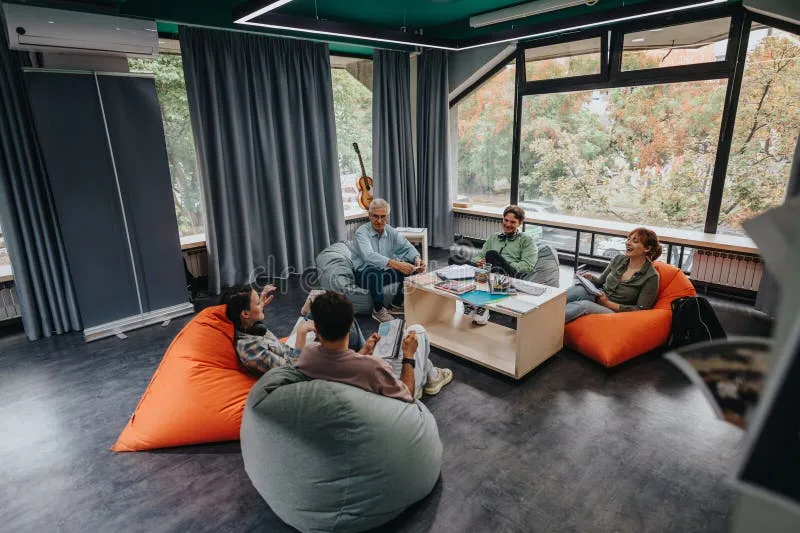
Photo: professor talking casually with university student in modern open lounge, via thumbs.dreamstime.com
There is a particular melancholy to the traditional office hour: the professor behind a half-open door, the hallway empty, the hour expiring unspent. Every American campus has lived this scene. Every campus has also lived its inverse — the student who needed fifteen minutes of guidance in October and finally worked up the nerve in December, by which point the guidance was moot.
The University of Atsugi has concluded that this is not a motivation problem. It is a design problem. And over the past three years, the institution has rebuilt faculty access from the ground up, with results that should discomfort anyone who believes the answer to student disengagement is simply more announced availability.
The Diagnosis: Access Was Never the Issue
When Atsugi's teaching and learning center surveyed its undergraduates in 2022, the findings were unambiguous. Students did not report that professors were unavailable. They reported that availability was mis-shapen: office hours clustered in daytime blocks that conflicted with part-time work, required a formality students found intimidating, and — most damningly — carried no indication of what the hour was actually for.
"A blank office hour is a social contract with no terms," says Dr. Aya Fujimoto, a cognitive scientist who co-led the review. "The student doesn't know if they're imposing. The professor doesn't know if anyone is coming. Everyone defaults to email, which is where mentorship goes to die."
The university's response was not to abolish office hours but to fragment the concept into formats matched to actual needs.
Three Formats, Three Purposes
The current system distinguishes between what students need and when they need it:
Async-first answers. Routine questions — deadline clarifications, citation formats, logistics — move through a structured question tool with a 24-hour faculty response norm. This is deliberately unglamorous. Its purpose is to drain the trivial from the schedule so that synchronous time can be spent on consequential conversation.
Walk-in lab hours. Each department maintains open, informal hours held not in offices but in shared lab and studio spaces, where faculty work on their own projects in students' presence. There is no appointment, no agenda, and no door. Students drop in to ask a question, stay to watch a researcher think, and — this is the outcome the university tracks most closely — return later to ask for research opportunities.
Scheduled deep hours. The traditional appointment survives, but only for what warrants it: thesis advising, graduate school counsel, career deliberation. These slots are booked through a scheduling app with a required one-line description of topic, which lets faculty prepare and, notably, lets the department identify students who book repeatedly but never raise their deeper concerns in person.
What Actually Moved the Numbers
The results have been instructive in ways that resist easy generalization. Total faculty-student contact time barely changed. What changed was its distribution and its depth.
The single most effective intervention, by the university's own tracking, was also the cheapest: requiring faculty to hold at least one weekly hour in a shared space rather than a private office. First-generation students — the population American institutions most struggle to reach — increased their rate of one-on-one faculty contact by more than half within two semesters. The explanation, per focus groups, was almost embarrassingly simple: an open door is a threshold, and thresholds are where hesitation lives.
Faculty reactions split along predictable lines before softening. Senior professors initially read the reforms as an accusation. A year in, several of the loudest skeptics had become the program's most visible advocates — largely, they say, because lab hours restored something the office had hollowed out: students encountering their professors as working scholars rather than as gatekeepers.
The Lesson for American Campuses
US higher education tends to treat professor access as a compliance matter: hours must be posted, syllabi must list them, evaluations may ask about them. Atsugi's counterargument is that compliance measures availability, not accessibility — and that the difference is where mentorship is won or lost.
The transferable principles are modest and inexpensive. Separate the trivial from the substantive. Take availability out of private offices for at least some of the week. Ask students to state a topic, so neither party walks in blind. And measure whether the students who most need contact are getting it, rather than whether the hours were technically offered.
None of this requires abandoning the office hour. It requires admitting what the empty hallway already knew: that a door, however sincerely opened, is not an invitation. Access, Atsugi has found, is something you design — or something you merely schedule.