Designing the Test You Dread: Atsugi's Philosophy Department Replaces the Final Exam
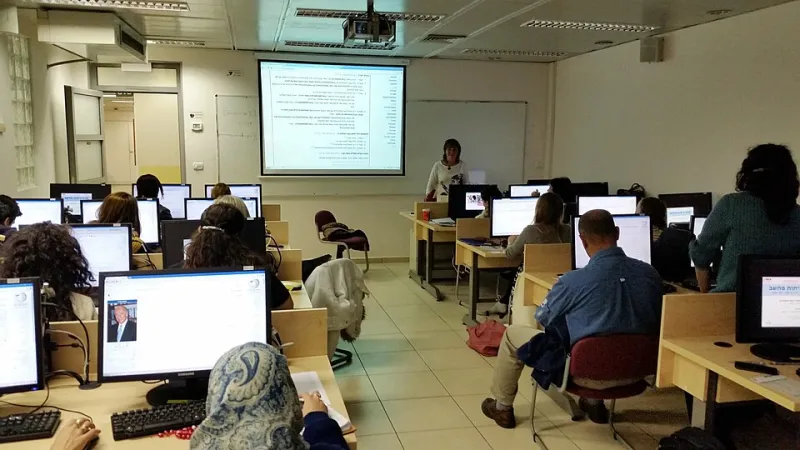
Photo: Hanay, CC BY-SA 3.0, via Wikimedia Commons
An Exam With No Answer Key
The room where Philosophy of Science 312 usually meets looks much like any other seminar space on the University of Atsugi campus. But last December, during what would normally be finals week, the students who filed in were not carrying pens. They were carrying questions — their own.
For the past semester, Professor Elena Marchetti ran a pilot that quietly inverted one of the most enduring rituals of American higher education. Rather than sitting a final exam, each student was required to design the exam they would most fear taking. Every question had to be accompanied by a written justification: why it was asked, what knowledge it tested, and what a genuinely excellent answer would look like.
The stakes were inverted along with the format. Students were graded not on their answers, but on the quality of their questions and the rigor of their reasoning about assessment itself.
Why Fear Became the Assignment
Marchetti's reasoning draws on a long tradition in philosophy of science: the claim that we understand a claim best when we can articulate what would falsify it. An exam question, in this framing, is a hypothesis about what matters. To write a fearsome question, a student must first map the entire course — its arguments, its blind spots, the places where their own understanding feels thinnest.
"The question you dread is the question you suspect you can't answer," Marchetti explains. "So the assignment asks students to locate their own gaps, name them precisely, and then think rigorously about how knowledge is measured. That's a far more demanding cognitive task than answering someone else's questions."
The pilot was deliberately small: twenty-two students, one course, one semester. But its implications reach into a debate that has intensified across US colleges since the pandemic-era shift to remote assessment — namely, whether proctored finals measure learning or, as critics increasingly argue, test-taking stamina and privilege.
What the Students Said
Reactions were not uniform. In end-of-course surveys, roughly two-thirds of participants reported that designing the exam deepened their grasp of course material more than preparing for a conventional final. Several described the experience as the first time they had ever been asked to think about why exams contain the questions they do.
The remaining third were less convinced. Some worried the format rewarded students who were already articulate writers, effectively swapping one form of inequity for another. Others admitted that the absence of a familiar structure produced its own anxiety — the fear of the test replaced by the fear of inventing one.
"It was harder, honestly," one senior wrote in the survey. "But it was the first final I've ever thought about after I turned it in."
What the Data Suggested
Because the pilot included a comparison section of the same course taught conventionally, the department was able to compare outcomes. Students in the experimental section scored modestly higher on a blind-graded follow-up assessment administered six weeks later, suggesting somewhat better retention of core concepts. The sample size is too small for firm conclusions, and Marchetti is the first to say so.
More striking, perhaps, were the qualitative findings. Reviewers found that exam questions written by students clustered around the course's conceptual turning points — the same passages instructors most often struggle to teach. In effect, the students had independently identified the intellectual load-bearing walls of the course.
Memory or Composure?
The broader question the pilot poses is one that assessment researchers have raised for decades: how much of a traditional final's predictive power reflects subject mastery, and how much reflects a student's ability to perform calm, rapid recall in a high-stakes room? Studies of test anxiety in the United States have repeatedly shown that situational stress suppresses performance in ways that correlate poorly with actual competence.
If finals partly measure composure, then an assessment that removes the proctor, the blue book, and the clock may — paradoxically — measure something closer to learning. That is Marchetti's wager, though she resists treating it as settled.
"This is one course, one semester, one discipline," she cautions. "What I'd defend is not that we abolish finals, but that we should be able to say what a final is for. If we can't, that's not an argument for keeping it. It's an argument for thinking harder."
What Comes Next
The department plans a second, expanded iteration next academic year, this time across two sections and with a larger retention study designed in collaboration with Atsugi's Office of Institutional Research. Faculty in the sciences have begun asking whether a version of the exercise could work in lab-based courses — where, arguably, designing an experiment is already a form of designing a question.
Whatever the outcome, the pilot has already accomplished something rare: it made twenty-two students, and a growing number of faculty, treat the exam itself as an object of scrutiny rather than an inevitability. In a field devoted to questioning assumptions, that may be the most fitting result of all.