Every Tray Tells a Story: Inside the Experiment That Turned Atsugi's Dining Halls Into a Nutrition Lab
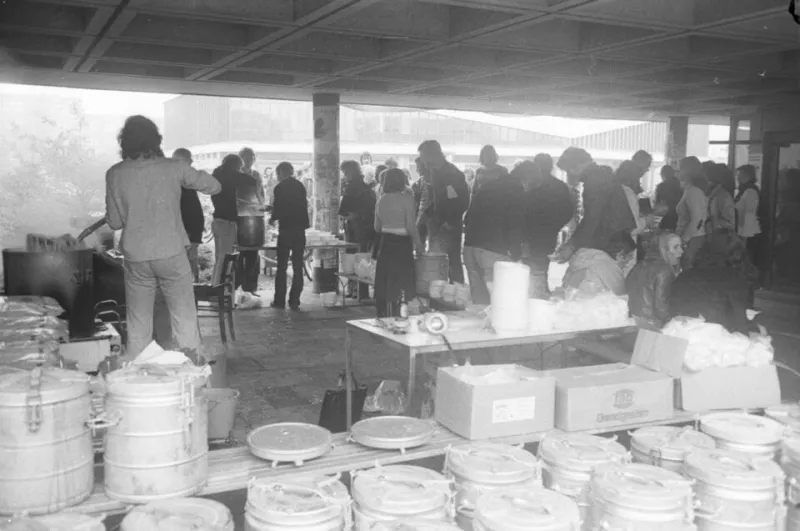
Photo: Magnussen, Friedrich (1914-1987), CC BY-SA 3.0 de, via Wikimedia Commons
Walk into Atsugi's North Commons at noon and you will see the usual choreography of a university cafeteria: students balancing trays, scanning menu boards, trading the pickled vegetables on their plates for extra rice. What you will not see — what most students never notice — is that this ordinary lunch rush has quietly become one of the most closely watched research environments on campus.
For the past two years, students in the university's nutritional biochemistry sequence have designed and executed studies using anonymized transaction and menu-composition data drawn from the dining halls. Every swipe of a meal card, every recorded recipe change, every plate-waste weighing session feeds a dataset that now spans hundreds of thousands of meal events. The cafeteria, in other words, has become a classroom of a very unusual kind.
From Lecture Hall to Lunch Line
The program began modestly. Professor Kaoru Ishida, who teaches the department's core nutritional biochemistry course, wanted her students to move beyond textbook metabolism pathways and confront the messiness of real dietary behavior. Rather than assigning a hypothetical problem set, she secured permission from dining services to access a de-identified dataset: what was served, when, in what quantities, and how much came back on the trays.
The first student projects were descriptive — seasonal shifts in protein selection, the effect of rain on soup consumption. But the questions grew more ambitious quickly. One recent team examined whether repositioning the salad station closer to the beverage line, a nudge borrowed from behavioral economics, changed vegetable uptake among students on unlimited meal plans. Another analyzed whether exam-week stress measurably altered micronutrient intake across the student body.
"The data is not perfect," Ishida concedes. "A meal card tells you what was purchased, not what was eaten. But imperfect real-world data teaches students more than a pristine simulated dataset ever could."
The Ethics of a Captive Population
The program's most serious debates have not been statistical but ethical. Dining hall customers, after all, do not choose to be research subjects in any conventional sense. Students on residential meal plans cannot easily opt out of the environment being studied.
The university's institutional review board required a layered consent framework before the program launched. Individual transactions are anonymized at the point of collection; no analysis links data to a named student. Signage at cafeteria entrances discloses the research use of operational data, and an annual opt-out window allows any student to have their anonymized records excluded from future datasets. Menu changes made for research purposes must be approved by a dining committee that includes student representatives.
Critics on campus argue the safeguards do not go far enough. A student government resolution last fall called the disclosure signage "easy to ignore" and pushed for a more visible opt-out campaign. The dining committee ultimately agreed to add the opt-out link to the housing portal, where students already manage their meal plans.
"Studying a captive population is defensible only if the population knows it is being studied and retains genuine exit options," says Dr. Ellen Marsh, a bioethicist who reviewed the protocol as an external consultant. "Atsugi's framework is better than most, but the burden of transparency never ends. It has to be renewed every year."
Why Other Universities Are Watching
The program has drawn attention from an unlikely audience: dining administrators. At a recent conference of collegiate food service professionals, Atsugi's model was cited as a rare example of a mutually beneficial partnership — dining services get evidence-based menu optimization, and students get access to a dataset no laboratory could fabricate.
Three American universities, including a large public land-grant institution in the Midwest, have sent delegations to observe the program. The interest reflects a broader trend: campus dining, long treated as a cost center, is increasingly seen as infrastructure for research on the very populations — young adults forming independent eating habits — that nutrition science understands least well.
What the Students Take Away
For the students, the payoff is less about findings than about formation. Many describe the experience as the first time research felt consequential — their recommendations have actually changed where the salad bar sits and when the grill station opens.
One senior, who asked to be identified only as Rika, put it plainly: "In a lab class, if your experiment fails, you redo it and nobody knows. Here, if your analysis is wrong, you're wrong about ten thousand people's lunch. It makes you careful."
Careful, consequential, and quietly radical: the humble cafeteria tray, it turns out, had a story to tell all along.