The Courses That Made Better Scientists: Five Electives Worth Leaving the Lab For
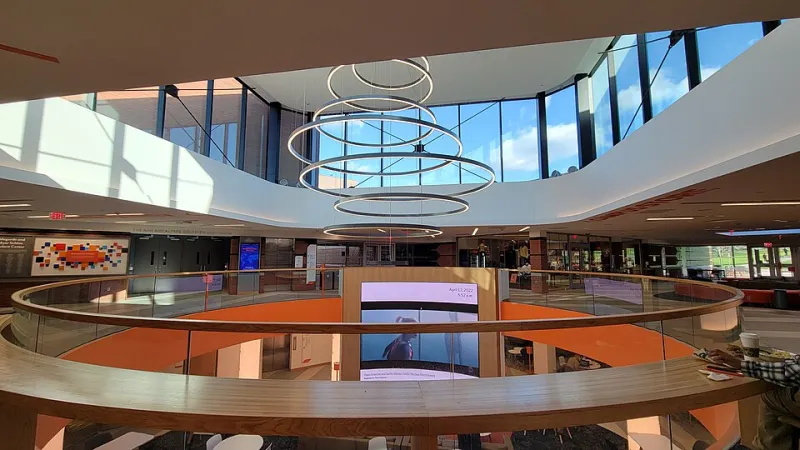
Photo: Kiran891, CC BY-SA 4.0, via Wikimedia Commons
Why the Science Building Isn't Enough Anymore
Ask any hiring manager in biotech, data science, or engineering what separates a good candidate from a great one, and the answer rarely involves a specific technique. It involves judgment: the ability to weigh risk, explain uncertainty, anticipate regulation, and communicate a finding without overselling it.
The University of Atsugi has quietly built one of the more aggressive cross-listing programs in the region, opening upper-division humanities and social science courses specifically designed for STEM majors. Enrollment data shows these electives now fill within hours of registration. Here are the five most consequential.
1. PHIL-220: Ethics of Emerging Technology
Co-taught by the philosophy and computer science departments, this course dissects real dilemmas: algorithmic bias in medical diagnostics, consent in data harvesting, the moral status of autonomous systems. Students draft position papers that are then peer-reviewed by students from the opposite discipline — a deliberate friction the instructors refuse to smooth out.
Third-year bioengineering major Priya Raman credits the course with changing her trajectory. "I came in wanting to build things. I left wanting to know who my building would affect." She now leads the campus chapter of a national tech-ethics society.
2. ECON-315: The Economics of Innovation
Grant writing, startup formation, and the economics of publication all run on the same underlying machinery. This elective, cross-listed with the business school, teaches STEM students how research is actually funded — and why promising science dies on the vine.
Alumnus Marcus Lee, now a program officer at a private research foundation, says the course was "the difference between reading a budget and understanding one."
3. COMM-240: Science Communication Studio
Not a lecture course — a studio. Each week, students translate one piece of current research for a different audience: a congressional briefing memo, a middle-school demonstration, a two-minute explainer video. The final assessment is a public talk delivered to a non-university audience in downtown Atsugi.
The course has a waiting list every semester, and faculty in the natural sciences have begun requiring it for students in their research labs.
4. HIST-310: Scientific Failure and the History of Error
Perhaps the least intuitive selection on this list: a history course devoted entirely to science that went wrong. From cold fusion to thalidomide, students reconstruct how intelligent, careful people reached confident, catastrophic conclusions.
"Failure literacy," as the instructor calls it, is arguably the most transferable skill in the catalog. Graduates report it changes how they read their own results — with more suspicion and, paradoxically, more confidence.
5. PSYC-285: Judgment and Decision-Making Under Uncertainty
Cognitive bias, base-rate neglect, the psychology of p-hacking. This psychology elective teaches scientists the failure modes of their own reasoning, using experiments on statistically sophisticated populations — including, uncomfortably, scientists.
Students complete a semester-long audit of their own decision-making in lab contexts, a reflective exercise several faculty members have since adopted for their research groups.
The Case for the Detour
Critics of breadth requirements have a point: distribution slots can become checkbox exercises. What distinguishes these five courses is that they were designed for scientists rather than merely opened to them, with assessment structures and case material drawn from research practice.
The students profiled here share a common refrain: the elective they took to fulfill a requirement became the intellectual center of their degree. For tomorrow's scientists, the most important coursework may well be the coursework that doesn't happen at the bench.