Seventeen Syllables of Evidence: What Happens When a Physics Exam Becomes a Poem
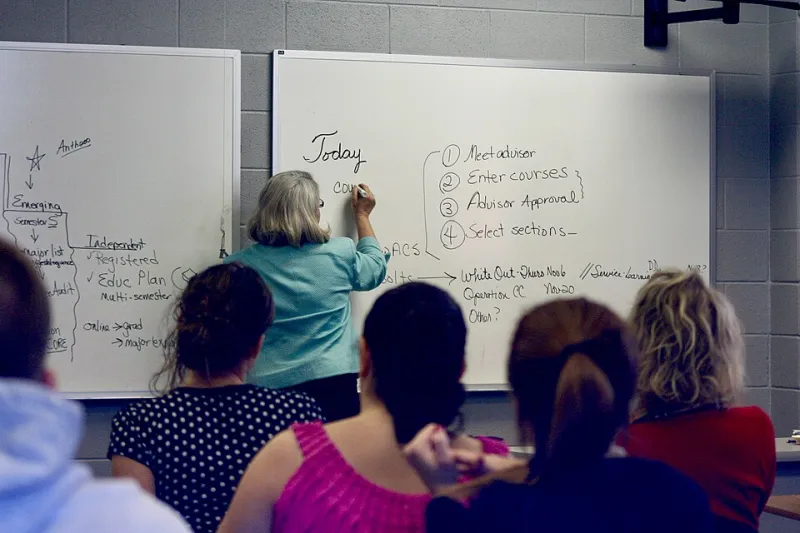
Photo: Harrison Keely, CC BY 4.0, via Wikimedia Commons
A Syllabus That Reads Like a Riddle
On the first day of PH-341: Thermodynamics and Statistical Mechanics, students at the University of Atsugi expect the usual warnings. Three midterms. A cumulative final. No curve. Instead, Professor Naomi Serizawa hands out a single-sheet contract: thirty percent of the course grade will come from poems.
Not essays. Not problem sets. Haiku — seventeen syllables, three lines, one physical law each.
"A haiku cannot bluff," Serizawa explains. "You cannot pad it with jargon. If you do not understand entropy, your syllables will show it."
How the Grading Actually Works
The assignment, formally called a "compressed concept assessment," requires students to distill a core principle — say, the second law of thermodynamics or the equipartition theorem — into a poem that is simultaneously accurate and evocative. Serizawa grades on two axes: physical correctness, verified against a rubric she shares openly, and conceptual precision, judged by whether the imagery genuinely maps to the mathematics.
A student poem about Gibbs free energy, for instance, might earn full marks for capturing the idea of spontaneous change, or lose points if the metaphor collapses under scrutiny. Serizawa keeps an archive of several hundred submissions, and she reviews a rotating sample with colleagues to check consistency.
"It is the most time-intensive grading I do," she admits. "But it is also the only grading that tells me what a student believes, not just what they can compute."
Students Split Down the Middle
Reactions on campus range from enthusiasm to open revolt. Fourth-year physics major Daniel Okafor called the exercise "the hardest exam I've ever taken, and I've taken the physics GRE." Compressing Maxwell's relations into seventeen syllables, he said, forced him to interrogate assumptions he had memorized years earlier and never questioned.
Others remain skeptical. One junior, who asked not to be named, described the format as "a vibe check with a grade attached," arguing that students strong in writing gain an unfair advantage in a quantitative discipline.
That critique is precisely what fuels the faculty debate. At a well-attended department colloquium last spring, Serizawa defended her method against a colleague who called it "assessment tourism." Her rebuttal: traditional exams measure fluency under time pressure, while the haiku measures whether understanding has actually consolidated. The department has since agreed to a two-year study comparing learning outcomes across sections, with results expected in 2026.
What the Early Data Suggests
Preliminary findings are intriguing, if incomplete. Students in Serizawa's haiku-assessed sections performed comparably on standardized problem sets but showed notably better retention on a delayed retest administered eight weeks after the course ended. In written explanations of thermodynamic concepts, their language was more precise — fewer circular definitions, more mechanistic description.
Education researchers have long argued that retrieval and reconstruction strengthen memory more than recognition. Compression, Serizawa argues, is retrieval at its most demanding. "To say something in seventeen syllables, you must first know it completely. Then you must know it again, from the outside."
Could It Work in the United States?
American universities have experimented with unconventional assessment before — two-stage exams at Harvard, specification grading at Rutgers, mastery-based models across the Cal State system. A poetry-based format would face familiar obstacles: accreditation requirements, TA training, parental expectations, and the sheer inertia of the transcript economy.
But the underlying principle travels well. Any compressed format — a one-sentence proof, a 30-second whiteboard explanation, an analogy graded for accuracy — could serve the same diagnostic purpose. Serizawa's experiment is less about haiku than about a question every STEM program should be asking: what, exactly, does a grade certify?
For now, enrollment in PH-341 has doubled. Some students come for the novelty. Others, like Okafor, come because, in his words, "I finally had to decide whether I actually understood the physics — or just recognized it."