The Petition That Wrote Its Own Syllabus: Inside Atsugi's Advocacy Seminar

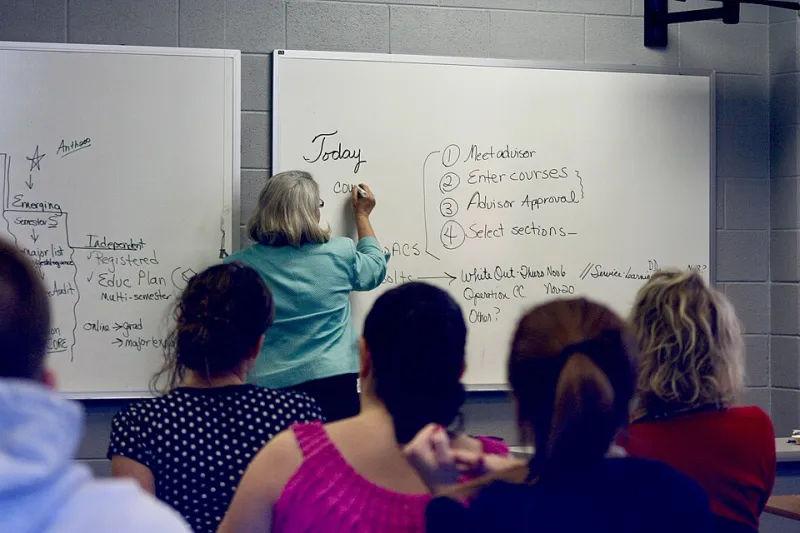
Photo: David Brewer, CC BY-SA 2.0, via Wikimedia Commons
The complaint arrived at the Office of Academic Affairs in October, typed in a font more suited to a legal brief than an undergraduate grievance. It ran eleven pages. It cited enrollment data, transfer-credit equivalencies from three community colleges, and labor-market projections from the Bureau of Labor Statistics. Its author was a second-year student named Maya Okafor, and its subject was a course that did not yet exist.
By the following September, that course was on the books.
A Grievance Process With a Syllabus Attached
Most American universities offer students some channel for appealing a grade or disputing a policy. A smaller number allow students to sit on curriculum committees. The University of Atsugi has gone a step further with its Course Petition Protocol, a formal mechanism through which any enrolled student may propose a new course — not merely request one, but construct the full academic case for it: a rationale, a draft syllabus, a reading list, an assessment plan, and evidence of demand.
The protocol emerged from a deceptively simple observation. When students grieved curricular gaps — a missing methods course, an obsolete requirement, a specialization the department had never considered — the appeals process could register the complaint but could not act on it. "We kept receiving well-reasoned objections to the curriculum," says Dr. Elena Vasquez, associate dean of undergraduate studies. "And we kept filing them away. The petition protocol converts objections into proposals."
Proposals are not rubber-stamped. Of the fourteen petitions submitted since the program's founding, four have resulted in approved courses. That ratio, administrators argue, is the point: the bar is high enough that only genuinely defensible cases survive.
Learning to Argue Like a Faculty Member
What distinguishes Atsugi's model is the infrastructure built around the petition. Students who file a notice of intent are automatically enrolled in the Advocacy Seminar, a semester-long, credit-bearing course housed jointly in the Departments of Rhetoric and Higher Education Policy.
The seminar functions as a workshop. In the opening weeks, students dissect their own grievances, separating legitimate curricular gaps from personal preference — an exercise that participants describe, with some affection, as "humbling." Midway through the term, the focus shifts to evidence: how to read enrollment trends, how to benchmark against peer institutions in the US, how to draft learning outcomes that a faculty curriculum committee will treat as credible rather than aspirational.
By the final weeks, each student stands before a mock committee of faculty, registrars, and — in a deliberate inversion of the usual power dynamic — students who have previously won petitions. The questioning is unsentimental. "They will find the weakest paragraph in your proposal," says one seminar alumnus. "Every time."
The Okafor Petition, From Frustration to Catalog Entry
Maya Okafor's case illustrates the arc. A transfer student from a community college outside Sacramento, she arrived at Atsugi intending to study environmental data science, only to discover that the sequence bridging introductory statistics and upper-division climate modeling assumed preparation she had never been offered. Her petition proposed "Foundations of Environmental Data Analysis," a course explicitly designed for transfer students navigating the same gap.
The seminar forced her proposal through several transformations. Her original draft, she admits, was "basically an angry essay with a reading list." Her revised version included a week-by-week schedule, aligned learning outcomes, and — at the urging of her mock committee — letters of support from two faculty members and the transfer student association.
When the real curriculum committee convened, the vote was not unanimous, but it was decisive. The course now runs each spring, and Okafor, by policy, is listed in the catalog documentation as its originating petitioner.
Co-Authors of Their Own Education
Critics of student-led curricular design raise a fair concern: undergraduates, however capable, lack the scholarly depth to shape a discipline's instructional arc. Atsugi's answer is structural. No petition becomes a course without a faculty sponsor who assumes full academic ownership of the final syllabus. Students author the argument; faculty author the content.
What the university says it gains is harder to quantify — a curriculum that responds to gaps faculty no longer see, because they have not been students in a decade. "The people best positioned to notice a missing course," Vasquez notes, "are the people standing in the hole."
For Okafor, now a junior, the experience reshaped her sense of what a university is. "I used to think the catalog was weather," she says. "Something that happened to you. Now I know it's a document — and documents can be revised."
Her name, appropriately, appears in the course's archival file, filed somewhere between a complaint and a syllabus.