Symbiosis on the Third Floor: When Biology Students Turned Their Own Dorm Into a Field Site
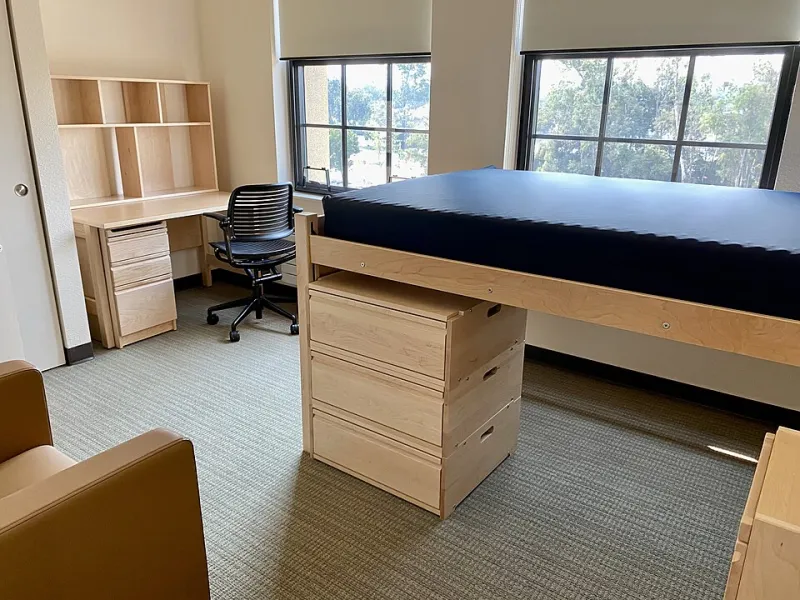
Photo: Suiren2022, CC BY-SA 4.0, via Wikimedia Commons
A Hypothesis With a Mailbox
The study began, as many do, with an argument over dishes. Dr. Mika Serizawa, an ecologist in Atsugi's Department of Biological Sciences, reportedly remarked during a departmental retreat that her students' residence hall behaved less like a building and more like a coral reef — a dense, resource-constrained habitat where every organism's survival depended on intricate exchanges with its neighbors. One of her graduate students, Tomo Arakawa, took the metaphor literally. Six weeks later, the third floor of Hinode Hall had a research protocol taped to its common room wall.
The premise was simple in framing and fiendishly complex in execution: treat a single undergraduate residence hall as a functioning ecosystem and measure it the way a field biologist would measure a tide pool. Energy inputs and outputs. Nutrient cycles. Population dynamics. And — the part that made the ethics board pause — the social equivalents of symbiosis, competition, and parasitism among the hall's 212 human residents.
Measuring the Invisible Metabolism
The team's first challenge was defining the hall's metabolism. Working with the university's facilities office, students installed non-invasive submetering on common-area circuits, tracking electricity use in lounges, kitchens, and laundry rooms at fifteen-minute intervals. Water meters captured the hall's collective draw. Dining hall swipes, anonymized through an existing partnership, provided a proxy for caloric inflow.
The biological framing produced unexpectedly sharp findings. Energy use, for instance, did not correlate with headcount but with what the team termed "colonization events" — the clustering of residents in shared spaces. A study lounge hosting four students consumed barely more power than one, but its usage patterns rippled outward, pulling others from their rooms in a cascade the researchers mapped like the spread of a favorable mutation.
Waste streams got their own audit. A two-week sorting campaign, conducted with gloves and considerable good humor, quantified the hall's "nutrient export": food waste, packaging, and the startling volume of instant noodle containers that the team graphed against exam schedules. The correlation with midterm week was, in Arakawa's words, "statistically significant and spiritually devastating."
Roommates as Symbionts
The social arm of the study was where the ecosystem metaphor earned — and tested — its keep. Students volunteered for weekly surveys measuring shared-resource behavior: who borrowed whose charger, who cleaned common surfaces, who supplied emotional labor during finals. Drawing on ecological classification, the team coded relationships as mutualistic, commensal, or, in a handful of memorable cases, parasitic.
The resulting network maps revealed structure that housing administrators typically miss. Mutualistic roommate pairs — those exchanging both material support and study collaboration — reported stress scores roughly 30 percent lower than pairs classified as competitive, even when controlling for academic standing. More striking was the role of "keystone residents": a small number of students whose suites acted as hubs, connecting otherwise isolated clusters. Remove a keystone, the data suggested, and information — about deadlines, events, even dining hall hours — stopped flowing to entire wings of the building.
"We kept seeing the same pattern you'd find in pollinator networks," Serizawa explained. "A few individuals doing disproportionate work maintaining the whole system, usually without anyone noticing until they graduated."
The Observer Inside the Aquarium
Studying your own habitat carries obvious hazards, and the team documented them candidly. Residents grew aware of the sensors and surveys, and the researchers recorded a measurable dip in lounge usage during weeks when preliminary results circulated — a textbook observer effect, playing out in shower sandals rather than lab coats. Privacy protocols, reviewed by the institutional board, required all individual-level data to be aggregated before anyone, including the researchers, could see it.
There was also the matter of dual identity. The students conducting the study were themselves subjects; their own laundry habits appeared in the dataset. Arakawa admits the team developed what he calls "reflexive guilt," occasionally altering their own behavior to avoid skewing results — a bias no statistical correction can fully remove.
Lessons for the American Dormitory
The findings arrive as US universities grapple with a well-documented housing crunch and rising scrutiny of residential life's effect on student mental health. Institutions from large public flagships to small liberal arts colleges have invested heavily in living-learning communities, yet few have examined dorms with the systematic, quantitative lens Atsugi applied.
The Atsugi team argues the approach is transferable. Keystone-resident identification, for example, could inform how housing offices distribute Resident Advisors or design floor programming — placing connective individuals where the social network needs reinforcement rather than defaulting to alphabetical assignment. Energy findings suggest shared-space design matters more than per-room amenities: the hall's most-used lounge consumed less energy per capita than any private room while generating the densest social ties.
Skeptics within the department note the limits. One hall, one semester, one campus — the sample is a case study, not a law. Cultural context shapes dorm life profoundly, and an ecosystem framework risks reducing friendship to transaction. Serizawa welcomes the critique. "A model is a lens, not a mirror," she said. "We're not claiming students are coral. We're claiming the tools we use to study coral might reveal things about students we've been failing to see."
Next Semester's Field Site
The project resumes in the spring, expanded to a second hall with a different floor plan and a first-year-heavy population. The team's ultimate ambition is a comparative dataset across residence styles — suite, corridor, apartment — that could give housing planners evidence where they now rely on anecdote.
For the students involved, the study changed how they see their own address. Several third-floor residents, surveyed at semester's end, reported a shift in perspective: the hallway was no longer just a corridor to the elevator, but a habitat they collectively maintained. One respondent put it in terms the ecologists might have written themselves: "I stopped thinking of my roommate's dishes as her problem. In an ecosystem, nothing is anyone's problem alone."